Two-phase flow
Two-phase flows play an important role in the atmosphere, in the ocean, and in industry, for example in clouds, sea spray, and heat exchangers.
We are trying to identify the fundamental laws that control the properties of these systems. Are turbulent flows of liquid water modified by the presence of air bubbles? Do these flows in turn affect the properties of the bubbles?
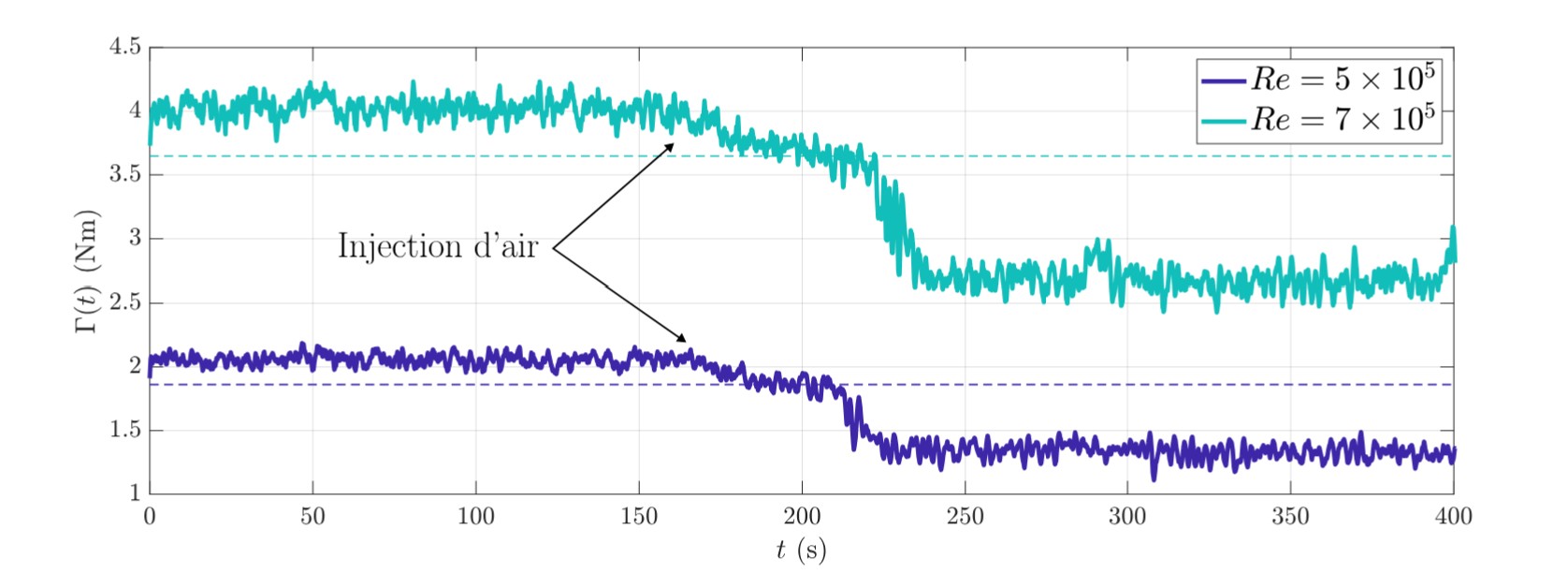
One example of a recent result is the discovery of a surprising and drastic reduction in the power required to maintain a given velocity in a turbulent liquid flow when a small fraction of gas is injected into it. This phenomenon is associated with a bifurcation in the flow structure that can be described by a low-dimensional dynamic system, despite the enormous number of degrees of freedom involved.
Drastic reduction of the torque in a swirling flow of air and water
V. Mouet Ph. D Thesis >>
Heat transport in Rayleigh Bénard convection with phase change
Physical Review Letters 134, 104001 (2025)

Spatial and temporal properties of turbulent flows
Spontaneous generation of temperature fluctuations. Effect on the propagation of sound. Behavior of the large scales of turbulent flow or in wave turbulence.
Europhysics Letters 141, 43002 (2023)
Europhysics Letters 140, 43001 (2022)
Physical Review Letters 128, 014501 (2022)
Physical Review Letters, (118), 144502 (2017)
1/f fluctuations of the large scales of a 2D turbulent flow
We studied the behavior of the large scales of a 2D flow generated by a small scale periodic in space forcing. These large scales display spontaneous reversals and exhibits 1/f fluctuations. These fluctuations result from the non trivial behavior of the intereversal waiting time that are distributed as a power-law.
EPL, (115), 64004, (2016)
Journal of Statistical Physics (161), 1379-1389 (2015)
Europhysics Letters (111), 44002 (2015)
Geophysical and Astrophysical fluid Dynamics 106, 468-492 (2012)
Bounding theories for turbulent and chaotic systems
Physics Letters A 326 (1-2), 85-92 (2004)
Physics of Plasmas 10 (11), 4314-4323 (2003)
Physics of Plasmas 10 (11), 4324-4334 (2003)