Earthquake physics
The statistical properties of earthquakes verify several laws, such as Gutenberg-Richter's law, which describes the distribution of energy released by an earthquake, and Omori's law, which governs the number of aftershocks following a major earthquake. These distribution laws have fairly simple expressions (they are power laws), whose precise characteristics are obtained empirically by studying earthquake catalogs. Together with colleagues in geophysics, physics, and mathematics, (see here) we are trying to understand the origin of these properties. The idea is to apply methods from nonlinear physics, signal processing, and statistical physics. Our results establish a connection between properties of statistical physics (random walks, percolation, random surfaces) and observations of natural data. See here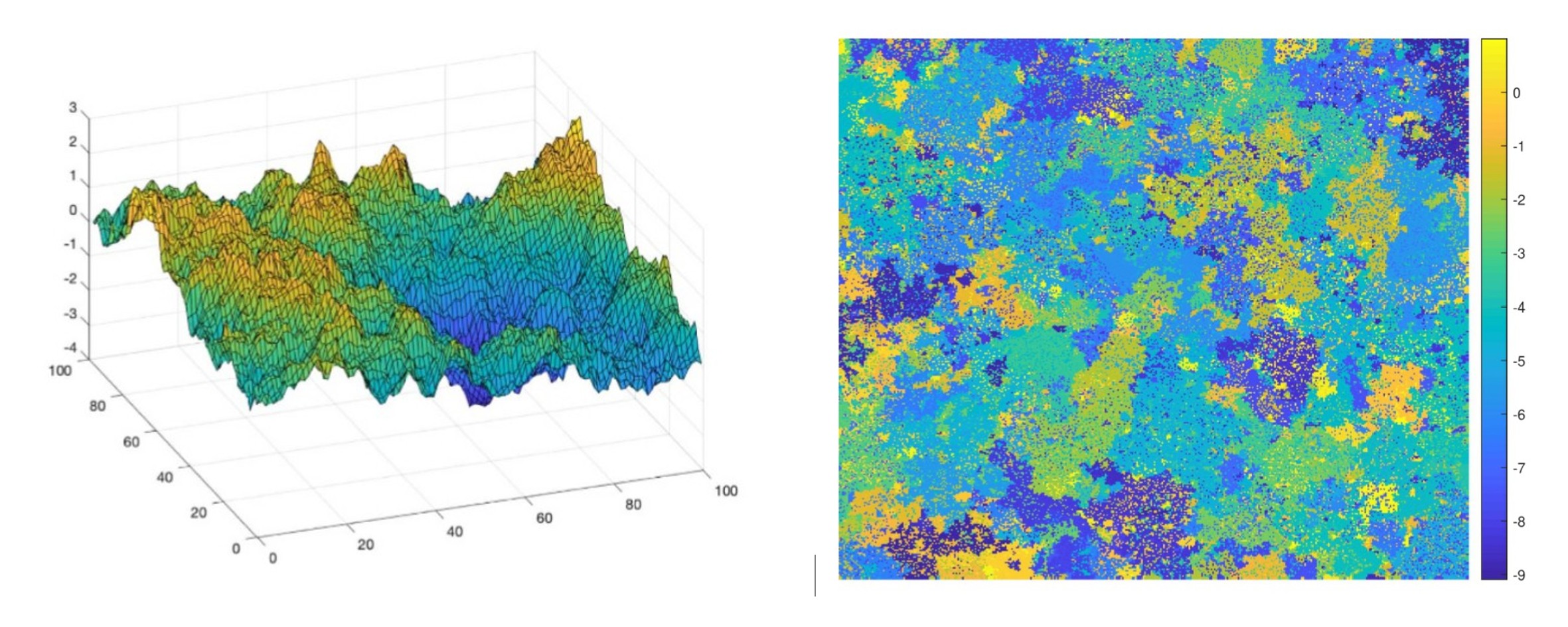
Physical Review E 110, 064804 (2024)

Journal of Statistical Mechanics, 043404 (2024)
Physical Review E 107, 034132 (2023)
Journal of Geophysical Research: Solid Earth, 128, e2022JB025583 (2023)
Journal of Statistical Mechanics, 023404 (2021)
Geophysical Research Letters (46), 7414-7423 (2019)