• 44 results

The aim of this lecture is to provide a description of quantum transport in disordered systems, with an emphasis on important phenomena like weak localization, Anderson localization and the Anderson metal-insulator transition. During the lecture, a number of important theoretical tools needed to describe quantum particle scattering in the presence of spatial disorder will be introduced in a pedagogical fashion, such as the Green's function technique, diagrammatic approaches to weak localization and transfer matrices. The lectures will be also illustrated by experimental examples and tutorials, especially taken from the physics of quantum gases and  condensed matter.
The goal of this course is to introduce the main concepts and challenges of quantum computing, a new set of technologies and techniques that promise to solve hard computational problems.


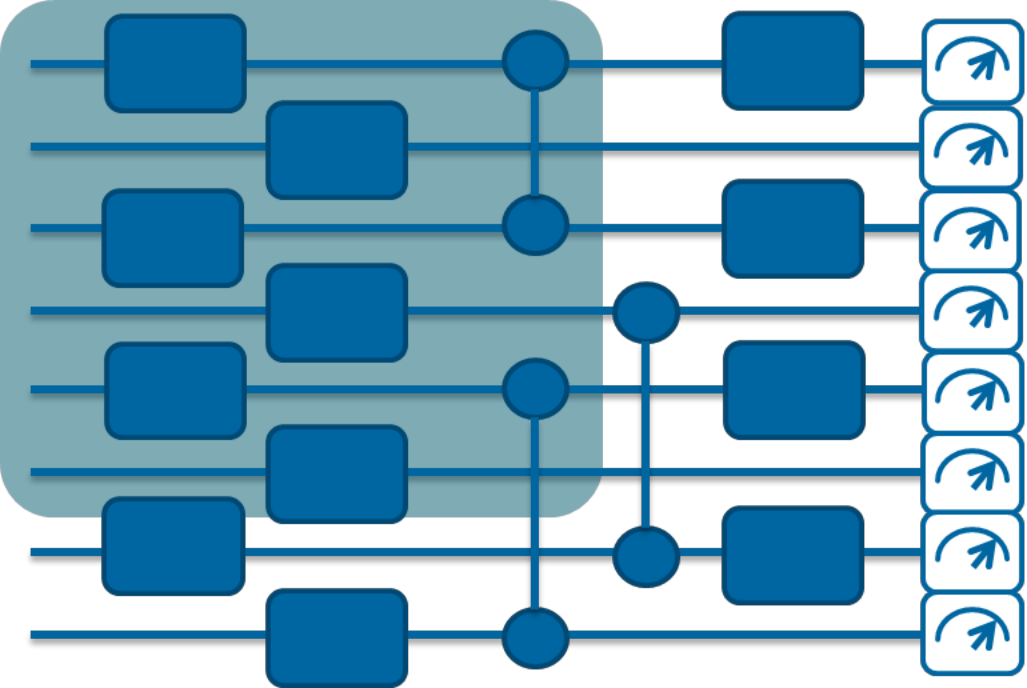
a quantum circuit

Recent years have seen enormous experimental progress in preparing, controlling and probing quantum systems in various regimes far from thermal equilibrium. Examples include systems as ultra-cold atomic quantum gases under time-dependent perturbations, driven non-linear cavity QED systems or strongly correlated electrons in solid-state materials under ultra-fast optical excitations.

Since the 80’s, laser cooling has enabled the production of sub-milliKelvin dilute atomic gases - which can be further cooled to the nanoKelvin regime.

This course is the continuation of the first semester course  "Introduction to quantum mechanics I".

We will treat the quantum mechanics of a particle in three spatial dimensions which will lead us in particular to the study of angular momentum in general  which in turn is closely relates to the rotations of space.  We will study central potential problems in general and the hydrogen atom in particular. The addition of angular momenta is discussed. We treat the quantum mechanics of a charged particle in an electromagnetic potential in some detail with emphasis on the notion of gauge invariance. The relativistic Dirac equation and its non-relativistic limit is briefly mentioned to obtain the correct coupling of the magnetic moment of spin 1/2 particles to a magnetic field. Symmetrisation and anti-symmetrisation for identical bosons and fermions is discussed and the second-quantised formalism is mentioned. The lecture ends with a discussion of the role of symmetries and the associated selection rules.